The Watchful Investor's Trap: How Constant Portfolio Surveillance Quietly Erodes the Wealth It Promises to Protect
Photo by Photo by TabTrader.com on Unsplash on Unsplash
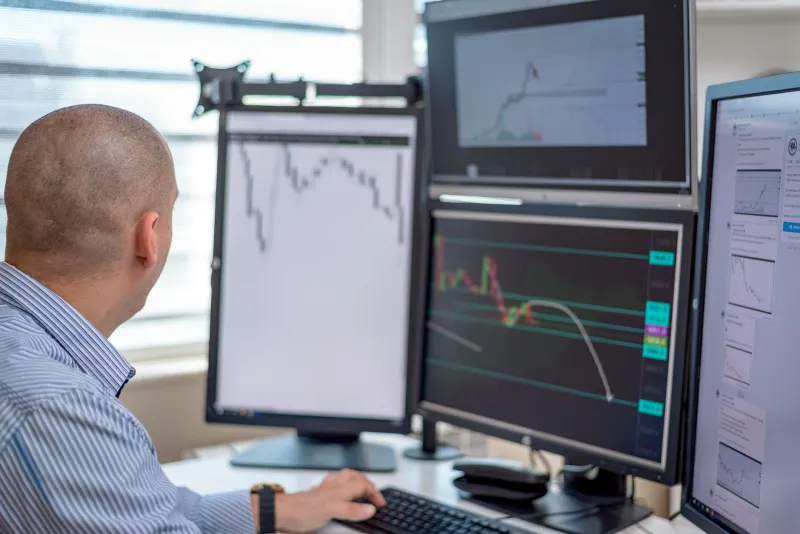
There is a particular type of investor who believes that vigilance is virtue. He checks his brokerage dashboard before his morning coffee. He reviews quarterly statements the day they arrive, cross-referencing each position against benchmark data. He schedules calls with his advisor after every notable market movement. He is, by most conventional definitions, a deeply engaged steward of his own capital.
He is also, in all likelihood, systematically destroying wealth.
This is not an intuitive conclusion. The American professional culture that produces most high-net-worth individuals is built on the premise that attention yields results — that the person who monitors most closely wins. In business operations, that premise often holds. Applied to investment portfolios, it reliably backfires. The mechanisms through which excessive oversight destroys value are real, measurable, and stubbornly resistant to correction, precisely because they feel like responsible behavior while they are occurring.
What the Data Actually Shows
Research from behavioral finance has consistently documented what practitioners call the "activity penalty" — the measurable return drag created by frequent trading and tactical reallocation. Studies examining retail and institutional investor behavior over multi-decade periods find that the most active segments of the investor population underperform passive benchmarks by margins that compound dramatically over time. The gap is not explained by fees alone, though fees matter. It is explained primarily by the timing of decisions.
Investors who intervene frequently tend to sell into weakness and hesitate to re-enter until momentum is already established. They exit positions that subsequently recover and rotate into assets that subsequently decline. Each individual decision may feel rational in the moment. The aggregate pattern is consistently destructive.
What separates the precision-focused investor from the process-focused one is not intelligence or access to information. It is the frequency with which short-term data is allowed to trigger action. When every quarterly report becomes a decision prompt, the investor is essentially allowing the market's natural noise — the routine fluctuations that carry no meaningful signal — to drive capital allocation. The result is a portfolio that is perpetually out of position relative to where it was designed to be.
The Illusion of Control
Psychologists who study decision-making under uncertainty have documented a consistent human tendency to equate action with competence. When outcomes feel uncertain, doing something — anything — reduces anxiety more effectively than doing nothing, even when the action itself is counterproductive. In investment contexts, this manifests as the compulsion to respond to market volatility with portfolio adjustments, regardless of whether those adjustments serve the underlying strategy.
The investor who rebalances in response to a 12% market correction is not necessarily acting on a well-reasoned thesis about valuations. More often, he is acting on discomfort. The portfolio change produces a feeling of agency that temporarily suppresses the anxiety the correction created. That the adjustment may lock in losses, trigger taxable events, or remove exposure to the recovery that follows is a secondary consideration — or no consideration at all in the moment of execution.
This dynamic is particularly pronounced among high-net-worth individuals who have achieved success through direct, decisive action in their professional lives. The skills that built their wealth — rapid assessment, confident decision-making, intolerance for underperformance — are genuinely valuable in business contexts. Applied to long-duration investment portfolios, those same instincts become liabilities.
Opportunity Cost as the Silent Destroyer
Beyond the direct cost of mistimed trades, excessive monitoring creates a subtler form of value destruction through opportunity cost. The investor who is perpetually evaluating whether to exit a position is rarely positioned to hold it through the periods of volatility that precede its most significant gains. Long-term compounding requires surviving discomfort, not eliminating it.
Consider the asymmetry embedded in equity market returns. A substantial portion of long-term gains in major indices are concentrated in relatively brief windows. Missing even a small number of the market's best trading days — through being in cash, rotating to defensives, or simply having executed a tactical shift at the wrong moment — can meaningfully reduce a portfolio's terminal value over a 20- or 30-year horizon. The investor who checks his positions daily and acts on what he sees is statistically more likely to be out of the market during those windows than the investor who has committed to a defined process and holds to it.
This is what makes the precision penalty so insidious: the costs are invisible in real time. No statement line item reads "value destroyed by premature exit." The damage only becomes legible in retrospect, when the gap between what the portfolio returned and what a disciplined, lower-activity approach would have returned becomes too large to rationalize.
Deliberate Inattention as Strategy
The counterintuitive prescription — and the one that separates genuinely sophisticated investors from merely active ones — is a structured practice of deliberate inattention. This does not mean abandoning oversight entirely. It means designing a framework in which oversight occurs at intervals determined by strategy rather than by anxiety, and in which the threshold for action is defined in advance rather than improvised in response to market conditions.
Process-focused investors establish rebalancing triggers based on drift thresholds, not calendar dates or news cycles. They define in writing the conditions under which tactical adjustments are appropriate, and they hold to those definitions even when emotional pressure pushes toward deviation. They review performance annually rather than quarterly, reducing the frequency with which short-term noise can masquerade as meaningful signal.
Perhaps most importantly, they recognize that their advisor's value is not measured in the frequency of portfolio changes but in the quality of the framework that governs when changes are and are not warranted. An advisor who recommends action in response to every market development is not demonstrating diligence. He is demonstrating an inability to distinguish signal from noise — and charging for the privilege.
Building a Portfolio That Doesn't Need You
The most durable wealth-building structures share a common characteristic: they are designed to function without constant human intervention. Asset allocation decisions are made deliberately and revisited infrequently. Tax efficiency is built into the structure rather than managed reactively. Rebalancing is systematic and rules-based rather than discretionary.
This architecture does not reflect indifference. It reflects a sophisticated understanding of where human judgment adds value and where it destroys it. Judgment is valuable in the construction of a strategy. It is frequently destructive in its day-to-day execution, because day-to-day execution exposes judgment to the full force of cognitive bias, emotional reactivity, and information overload.
The investor who can resist the cultural imperative to demonstrate engagement through activity — who can treat restraint as a discipline rather than a failure of attention — possesses a genuine edge. Not because markets are efficient and nothing can be done, but because the primary competitor in long-term wealth building is not the market. It is the investor's own behavior.
Precision, properly understood, is not about monitoring more. It is about intervening less, and only when the framework demands it. That distinction, quietly maintained over decades, is where lasting wealth is actually built.